Introduction
In many situations—such as remote construction sites, outdoor events, and rescue operations—access to the power grid may be limited or even nonexistent. The mobile battery-powered power stations appear then as a reliable energy source, sustainable, environmentally friendly, quiet and high-performance. They provide power to your equipment without a generator, by generating electricity silently, without direct CO₂ emissions or fine particulate matter.
1. What is a mobile power station?
To fully understand its potential, let’s start by taking a closer look at its composition and how it works.
A portable mobile power station combines three main components:
A lithium-ion battery
A Battery Management System (BMS): provides real-time monitoring of the voltage, temperature, and balance of the battery cells.
An inverter: converts the direct current (DC) from the batteries into alternating current (AC), ready to power your equipment.
Unlike a diesel generator, which produces electricity through the internal combustion of fossil fuels (diesel, GNR, natural gas, etc.), an energy station:
Stores electricity from the grid or from renewable sources (solar panels)
Provides alternating current without combustion, eliminating CO₂ and particulate emissions while significantly reducing maintenance.
Now that we understand how they work, let’s see why these stations outperform generators in many ways.
2. Why use batteries as an alternative? The benefits of mobile power stations
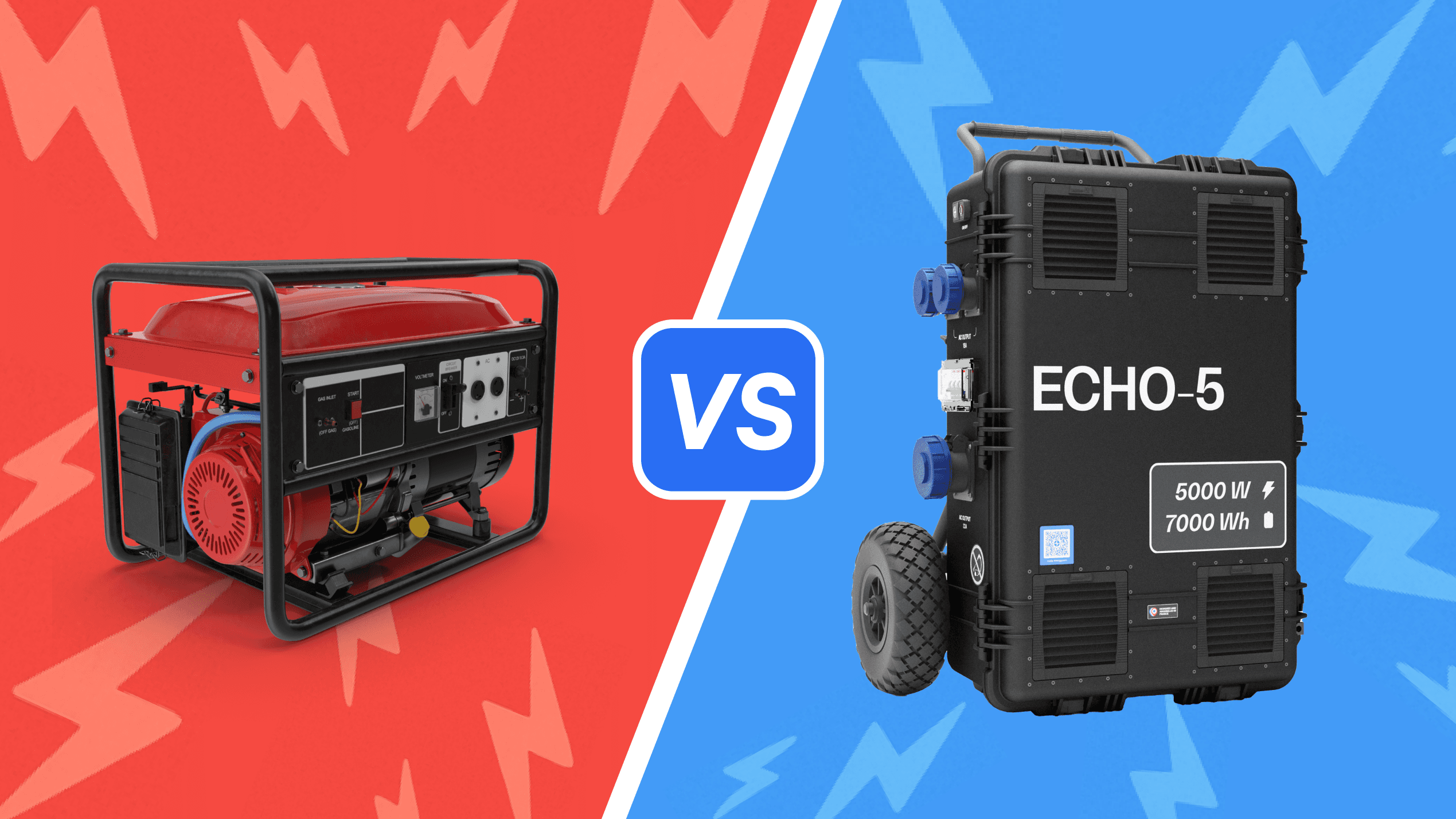
The mobile power stations offer a high-performance alternative to traditional generators, both economically and in terms of environmental and operational benefits.
💵 Drastically reduced energy costs
Let’s take a concrete example: a 6 kW diesel generator consumes an average of 1.53 L/h at 75% load, which is equivalent to approximately 4.5 kWh of electricity generated. With an average diesel price of €1.71/L (2024 price), this amounts to €0.58/kWh.
By comparison, a portable power station costs about €0.20/kWh to charge from the grid. Even when accounting for conversion losses (~10%), the effective cost remains around €0.22/kWh.
➡️ Result: 62% savings in daily use, which translates to hundreds or even thousands of euros saved each year with regular use (5 hours/day, 200 days/year). Not to mention the possibility of using thesolar energy, which allows you to split the bill even further.
📈 Optimized energy management
While generators often run idle, unnecessarily consuming fossil fuels, energy stations only discharge power when needed. It is also possible to schedule charging during off-peak hours to reduce costs and optimize usage cycles in order to extend battery life.
🔧 Virtually no maintenance required
Maintaining a generator is time-consuming and expensive: inspections, oil changes, filters, tests… This can take up to 37 hours a year and cost up to €1,000. In contrast, battery-powered stations require very little maintenance: no internal combustion engine, no fluids, and no complex mechanical parts.
🔇 Quiet operation and user-friendly design
Battery-powered stations are quieter (less than 35 dB), unlike noisy generators (> 80 dB). They help reduce noise pollution and can therefore be used indoors or in sensitive environments (downtown areas, nature reserves, film and TV shoots) without causing noise or vibration.
🌱 A significantly reduced environmental impact
One liter of diesel emits 2.6 kg of CO₂ for every 3.5 kWh generated, or 740 g of CO₂ per kWh. By comparison, the French electricity mix emits 53 g of CO₂ per kWh.
➡️ On the scale of a construction site or an event, this amounts to several tons of CO₂ avoided each year, not to mention the absence of fine particulate matter, odors, or pollutant emissions.
3. “Second-life” batteries: combining performance and circularity
“Second-life” batteries represent an innovative approach: they combine high performance, a lower environmental impact, and a circular economy model.
What are “second-chance” batteries?
These are brand-new lithium-ion modules that are either surplus stock or have minor cosmetic defects (scratches, markings). Although they have never been used, these modules are not installed in vehicles because they do not meet the automotive industry’s strict standards.
➡️ Result: a fully functional but underutilized resource, which constitutes an ecological waste if not reused.
Guaranteed optimal performance
These batteries come from the latest generation of electric vehicles, which have very high performance requirements:
High energy density (≥ 260 Wh/kg) in a compact design;
Long service life (more than 2,000 cycles guaranteed);
Reliability proven through rigorous testing protocols.
Economic and practical benefits
No loss of performance: 100% of the rated capacity is guaranteed.
Reduced environmental impact
Reusing these modules eliminates the need to produce new cells, thereby:
Up to 40% fewer CO₂ emissions over their lifecycle;
A reduction in electronic waste and the strain on critical resources (lithium, cobalt, nickel);
An active contribution to the circular economy without compromising on performance.
Over 500 kg of CO₂ avoided compared to manufacturing a new battery.
4. ECHO-5, the all-terrain mobile power station
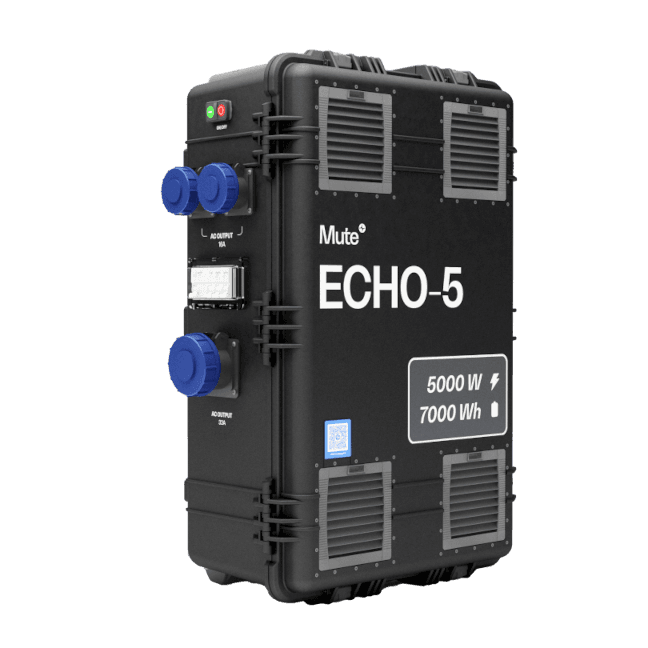
The ECHO-5 combines power, portability, and durability. Designed for professionals, it delivers reliable, continuous power in a compact, easy-to-carry design.
Technical Specifications
Power
5,000 W continuous AC output (plug-and-play)
Up to 9,000 W peak power
Storage capacity
6,850 watt-hours
Batteries
"Second-chance" modules—100% brand new
Energy density ≥ 260 Wh/kg, > 2,000 cycles guaranteed
BMS
Real-time monitoring: voltage, temperature, current
Automatic balancing, built-in protections
Refill
5 hours using standard charging via a 16A household outlet
Fast charging via a 16A household outlet in 3 hours
Compatible with solar panels
Size and durability
60 kg, dimensions: 80 × 52 × 31 cm
IP54: dust- and splash-resistant
Silence
< 35 dB(A) at 1 m, with no vibrations, fumes, or odors
➡️ The result: a self-contained, quiet, and clean solution designed to meet demanding energy needs (construction sites, events, film shoots), offering a quick and sustainable return on investment.
5. Comparison: Mobile Power Station vs. Generator
Criterion | 6 kVA diesel generator | Mobile power station |
|---|---|---|
Energy cost | 0.58 €/kWh | €0.22/kWh |
Maintenance costs | €300 to €1,000 per year | 0 € |
CO₂ emissions | 740 g/kWh | 53 g/kWh |
Noise level | > 80 dB | < 35 dB |
Weight/Mobility | 150 kg | 60 kg |
Conclusion: Toward a New Energy Standard
The mobile power stations Battery-powered vehicles are no longer a niche option, but a technically and economically viable solution, ready to replace a generator in most cases. Their superiority is clear: savings ofenergy, zero maintenance, emissions reduced by a factor of 14, virtually no noise, and greater mobility. While offering the same performance, they meet today’s needs for flexibility, energy efficiency, and the reduction of negative externalities.
In the short term, their adoption can be accelerated in sectors with strict regulatory or logistical requirements: construction, film production, events, and emergency response. In the medium term, the continued decline in battery prices and increasing environmental constraints (low-emission zones, diesel taxes, and CSR goals) will work in their favor.
By 2030, they could well become the new standard for off-grid energy.
This change is already underway: all that remains is to build on it.
Power. On.