ZFE 2026: Why Thermal Power Plants Are Disappearing from Urban Construction Sites
Yann Cousin
Reading time: 5 minutes
ZFE 2026: Why Thermal Power Plants Are Disappearing from Urban Construction Sites
Since 2025, a subtle yet decisive shift has been taking place on French urban construction sites: the use of diesel generators is declining. This is not due to a formal ban, but because they are gradually becoming unsuitable for the requirements imposed by Low-Emission Zones (LEZs), ICPE regulations, public building regulations, and public tenders.
By 2026, it will no longer be enough simply to supply energy. Energy solutions must also be compliant, quiet, emission-free, free of fossil fuel storage, and compatible with a QSE approach.
This article provides an in-depth analysis of this change, draws on current regulations, and presents a alternative viable already deployed in the field: the power station ECHO-5.
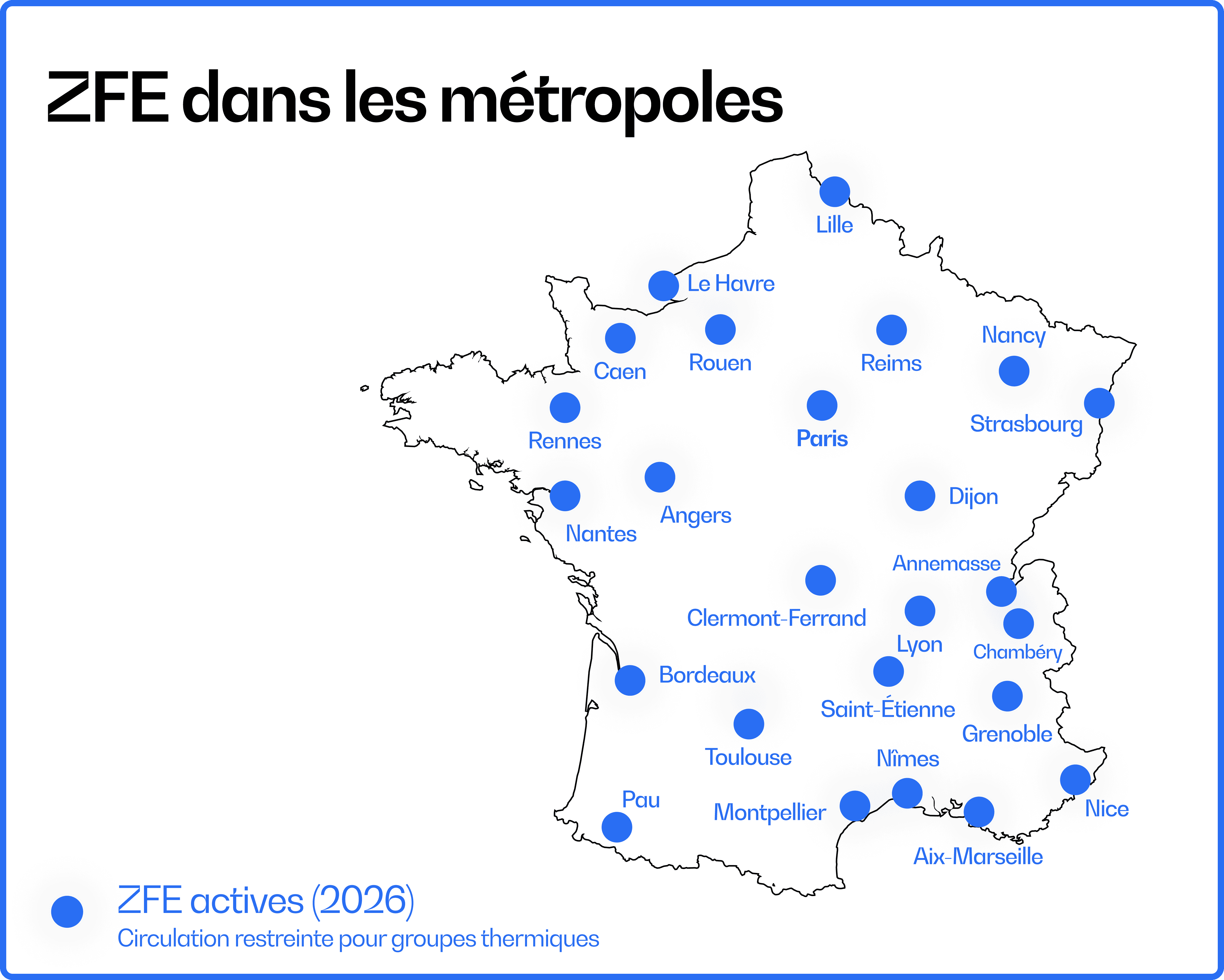
Table of Contents
ZFE 2026: A Requirement That Has Become the Industry Standard
Why diesel generators are no longer viable on urban construction sites
Practices in Major Cities in 2026: What’s Happening on the Ground
RFP: How Technical Criteria Rule Out Thermal Generators
The ECHO-5 power station: a compliant, quiet, and fuel-free solution
Use case: Power supply for construction sites without thermal constraints
FAQ: What the regulations say (and don't say) in 2026
Official sources and regulatory texts
Additional resources to download
1. ZFE 2026: A Requirement That Has Become the Industry Standard
Since January 2025, French urban areas with more than 150,000 residents have been required to implement a Low-Emission Mobility Zone (ZFE-m). This entails restrictions on vehicle access based on their emission levels (Crit’Air), particularly for diesel commercial vehicles classified as Crit’Air 3 and higher.
This regulatory framework has a direct impact on thermal power generators:
If the transport vehicle cannot access the site, the diesel generator cannot be deployed.
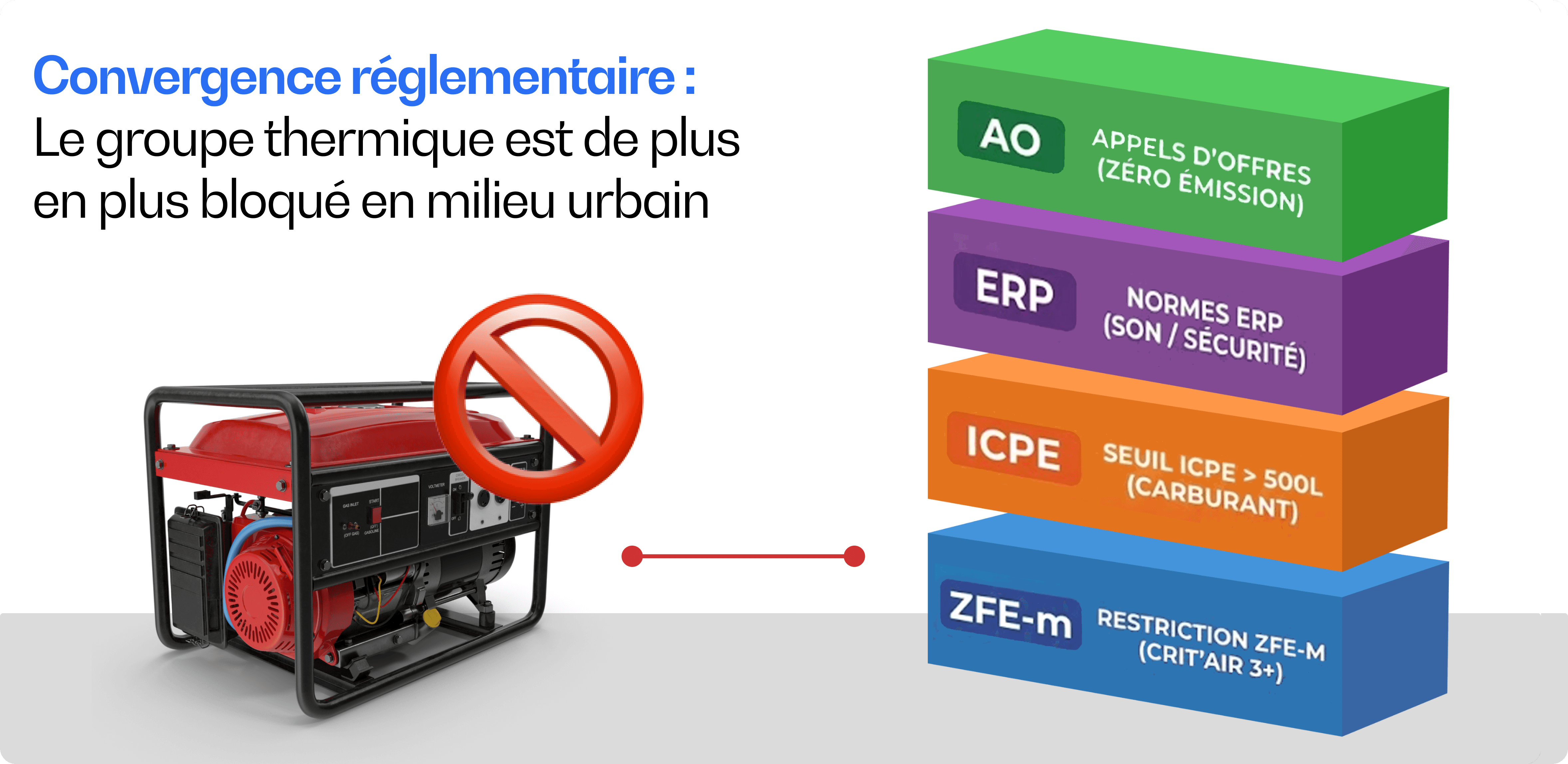
But low-emission zones are only the first challenge. By 2026, urban development projects will also have to contend with:
The ICPE threshold of 500 L fuel, triggering reporting requirements and safety restrictions
The specific regulations for public buildings, which limit noise pollution and fire hazards
The public specifications which now require solutions with zero direct emissions
In other words, while not formally prohibited, diesel generators are becoming structurally incompatible with regulated urban construction sites.
2. Why cogeneration plants are no longer viable on urban construction sites
For a long time, thermal units were considered a simple, reliable, and robust solution. Today, that approach is outdated.
Here's why their presence becomes problematic:
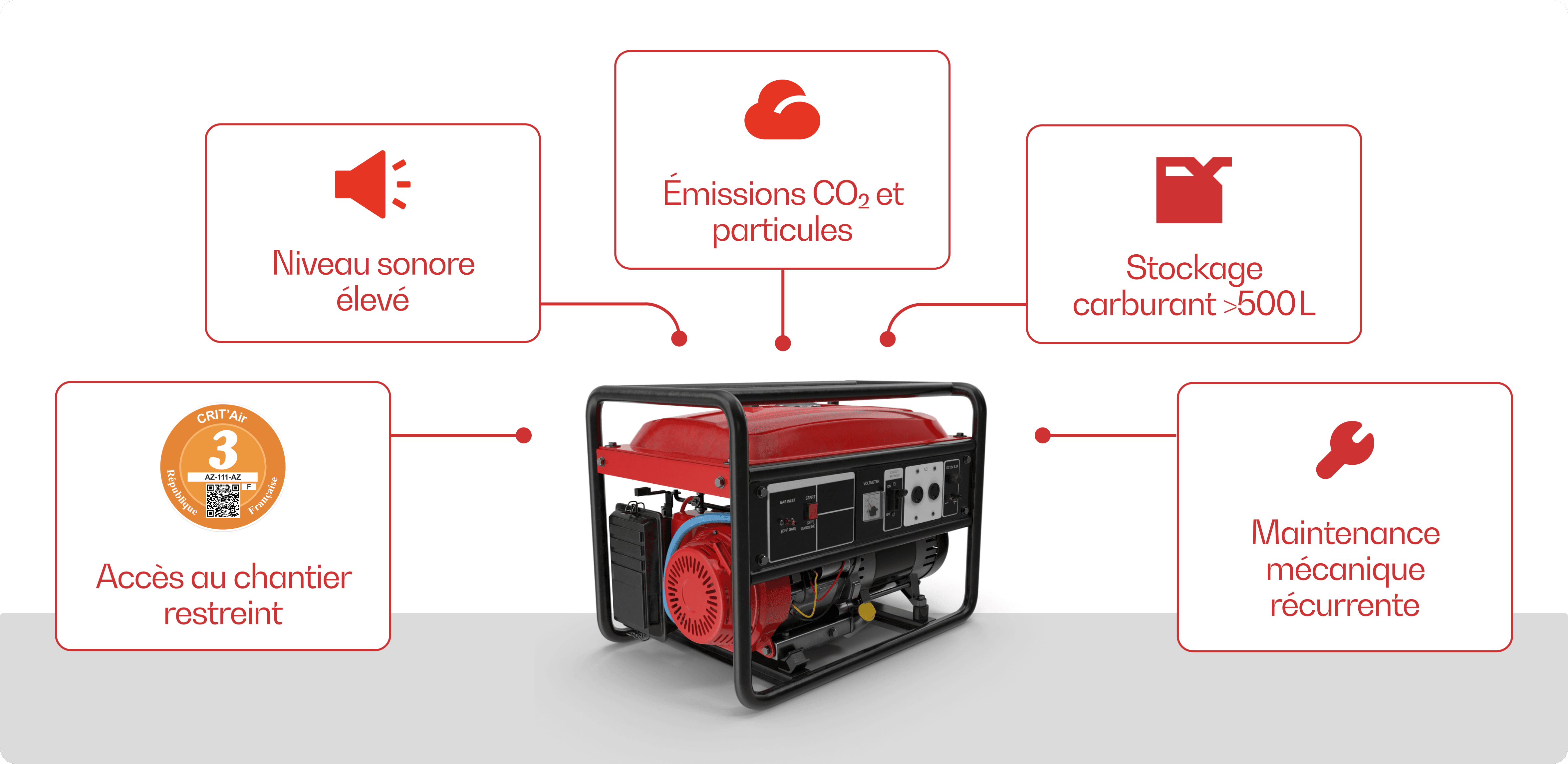
Access to the construction site restricted to Crit’Air 3 and higher vehicles
High noise level, often exceeding 75 dB, incompatible with public buildings or residential areas
CO₂ and particulate emissions, even with Stage V engines
Fuel storage > 500 L, subject to ICPE reporting requirements
Routine mechanical maintenance : fuel, filters, breakdowns
Growing incompatibility in conjunction with CSR and QSE initiatives
When these constraints are taken into account, the use of a thermal power plant becomes a factor in cost, risk, and non-compliance, far beyond simply supplying energy.
3. Practices in Major Cities in 2026: What’s Happening on the Ground
Laws establish a general framework. But it is local practices that reveal the fundamental change.
Paris
The Climate Plan 2024–2030 announces the phased phase-out of diesel generators in public spaces : a clear direction that points toward stricter local regulations in the coming years.
Prohibition on the use of generators with a capacity of less than 10 kVA in public spaces for certain purposes
Public procurement requiring energy sources with no direct emissions
Systematic integration of fossil fuel clauses in ERP tenders
Lyon
Extension of Low-Emission Zones to Non-Road Equipment
Local grants reserved for 100% electric vehicles
Bordeaux, Grenoble, Strasbourg
Very strict “clean construction site” standards
Thermal power generators are excluded from the selection criteria
These practices, which are already in place, show that thermal power generators are no longer considered acceptable, neither from a regulatory nor an operational standpoint.
4. RFP Processes: How Technical Criteria Eliminate Thermal Generators
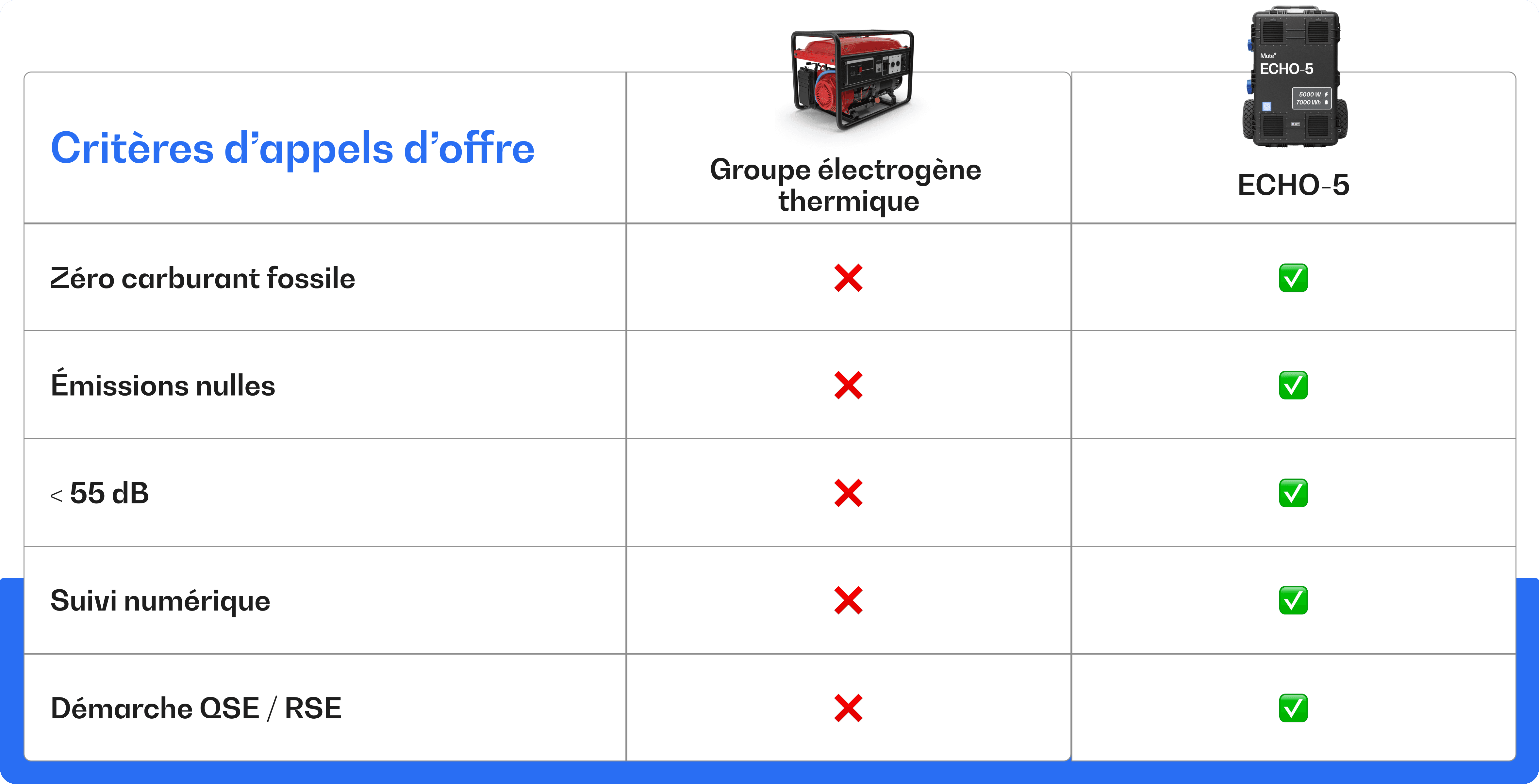
By 2026, public tenders will include selection criteria that, while not formally banning thermal power generators, effectively render them ineligible.
Examples of technical criteria observed
Zero fossil fuels
Zero emissions during operation
Noise level < 55 dB
Digital consumption tracking
Evidence of integration into a QSE/CSR approach
A thermal power generator cannot meet any of these criteria. Its inclusion in a technical file is therefore now a clear competitive disadvantage.
5. The ECHO-5 power station: a compliant, quiet, and fuel-free solution
In response to this trend, MUTE Energy has developed a ready-to-use solution: the power station ECHO-5. This is not a compromise or an adaptation, but a solution designed to address the challenges of urban construction sites from the design phase onward.
Technical Specifications
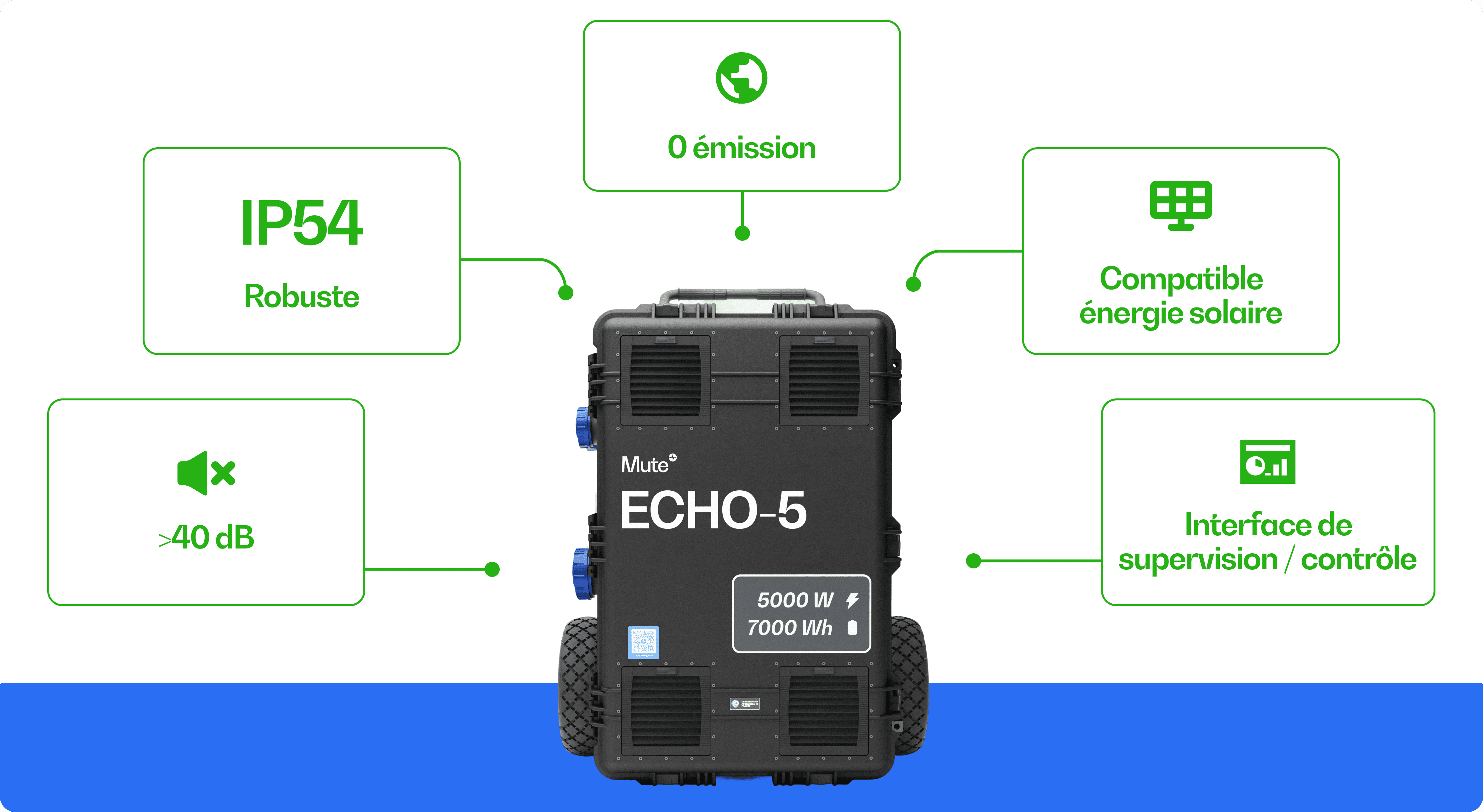
Zero direct emissions : no combustion, no smoke
Noise level < 40 dB : quiet operation
Charging via mains power or solar panels
IP54 rating : water- and dust-resistant
Connected control panel : visibility of consumption
Areas of application
Recharging power tools
Power supply for high-powered corded tools
Off-grid power supply for field camps
Work zone lighting
On-board power in emergency response trucks
Construction Projects in Confined Spaces
Nighttime construction and construction in noise-sensitive areas
Remote technical positions
The ECHO-5 enables the deployment of a mobile power supply immediately compatible in accordance with ZFE, ICPE, ERP, and QSE requirements.
6. Use case: Power supply for construction sites without thermal constraints
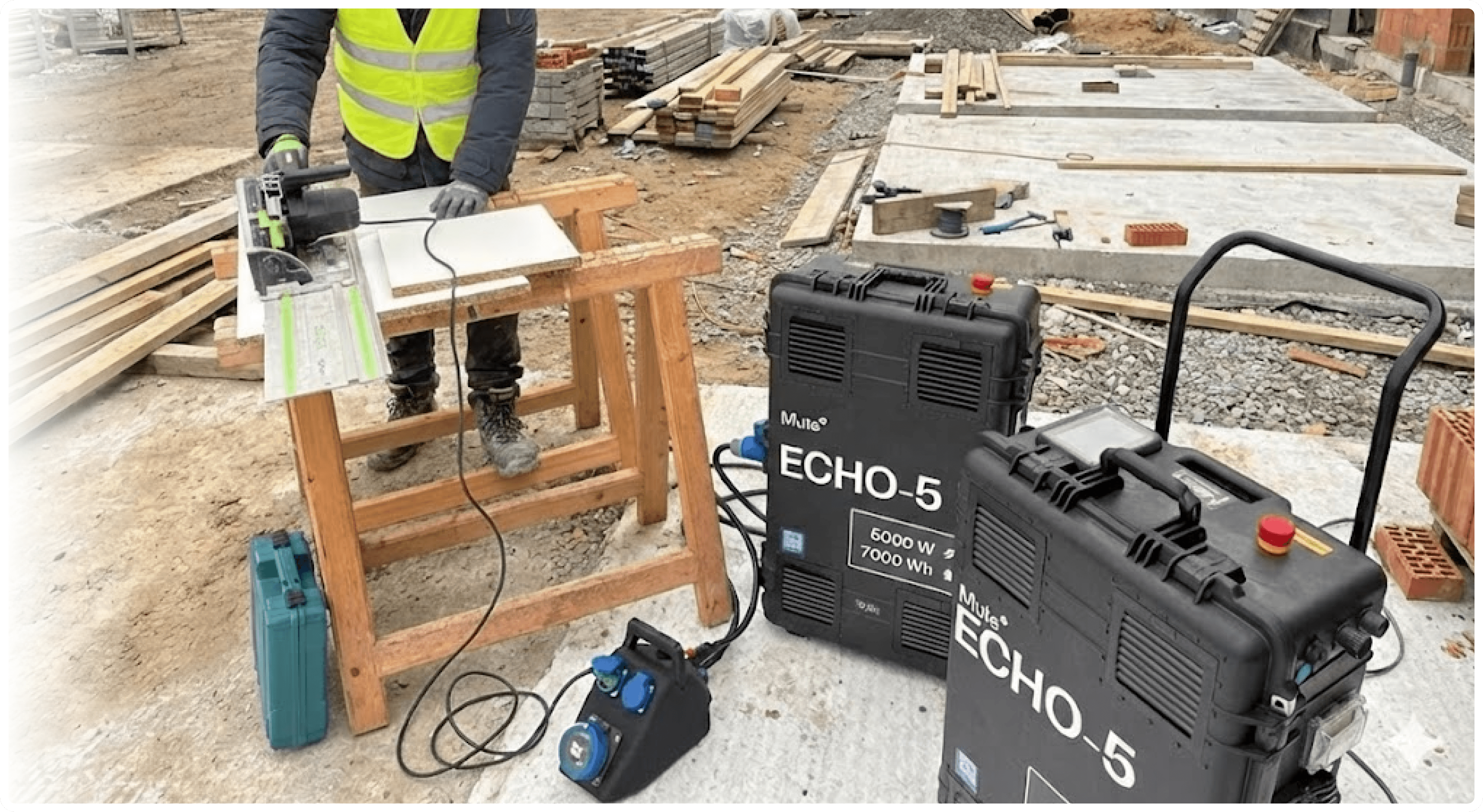
A concrete example: a construction site in a Low-Emission Zone (LEZ), near a public building.
The company is deploying an ECHO-5 station to:
Supplying tools and equipment to the camp
Avoid any complex logistics (fuel, cables, on-site equipment setup)
Comply with the noise limits in effect
Provide consumption reports that comply with the QSE framework
Eliminate the risk of non-compliance with ICPE or ERP regulations
This type of configuration makes it possible to address from the very beginning in accordance with the contract requirements of the project, without complexity or compromise.
7. FAQ: What the regulations say (and don't say) in 2026
Are diesel generators banned in France?
No. There is no national legal ban. However, Low-Emission Zones (LEZs), ICPE regulations, public building standards, and public tenders make them unsuitable in most cases.
Can they still be used in an ERP system?
Yes, in some cases. But beyond that 500 liters of fuel stored, an ICPE declaration is required. And many clients rule out fossil fuels entirely as a matter of principle, for safety and compliance reasons.
Is electric more expensive?
Not in the medium term. After 24 months of use, an electric charging station becomes more cost-effective :
No fuel
Less maintenance
Fewer breakdowns
No risk of the bid being rejected
8. Official sources and regulatory texts
LOM Act and ZFE-m Decree – service-public.fr
Stage V Standard – Regulation (EU) 2016/1628
Environmental Code – ICPE Section 1436
Fire Safety Regulations for Public Access Buildings
Eco-Responsibility Charter – City of Paris
Clean Construction Site Guidelines – Lyon, Grenoble, Bordeaux
ECHO-5 Specifications – mute-energy.com, abot.fr
9. Additional resources to download
Compare your emissions and savings in just a few clicks
Visit our website, on the tab "Calculators", for access our comparison tools.
Compare CO₂ emissions
Estimate the savings
Compare a diesel generator to theECHO-5